You grab a $100 card off the rack, pay, tuck it into a holiday card. Three weeks later your niece tries to use it. Balance: zero.
Nobody touched it after you bought it. Somebody touched it before.
That’s the quiet version of gift card fraud. The loud version rings your phone (or pings your inbox) with someone ordering you to run to the drugstore, buy cards and read off the codes. Learn both before Black Friday hits. Why bother? Because a gift card, once the money’s gone, acts like a twenty dropped on a sidewalk, and not much like the credit card in your wallet.
So how common is it?
Common. Gift cards or reload cards were the payment method in 41,120 fraud reports to the FTC’s Consumer Sentinel network in 2024, with $212 million lost, per the agency’s 2024 Data Book. (That’s the newest year with a payment-by-payment breakdown published so far.)
Zoom out to 2025 and the totals get uglier: 3 million fraud reports, $15.9 billion gone, according to FTC testimony to Congress in March 2026. Imposter scams alone? Over 1 million reports. And the agency itself says those numbers are only a fraction of what people actually lose, since plenty of victims never report.
The scams, one by one
Card draining on the store rack
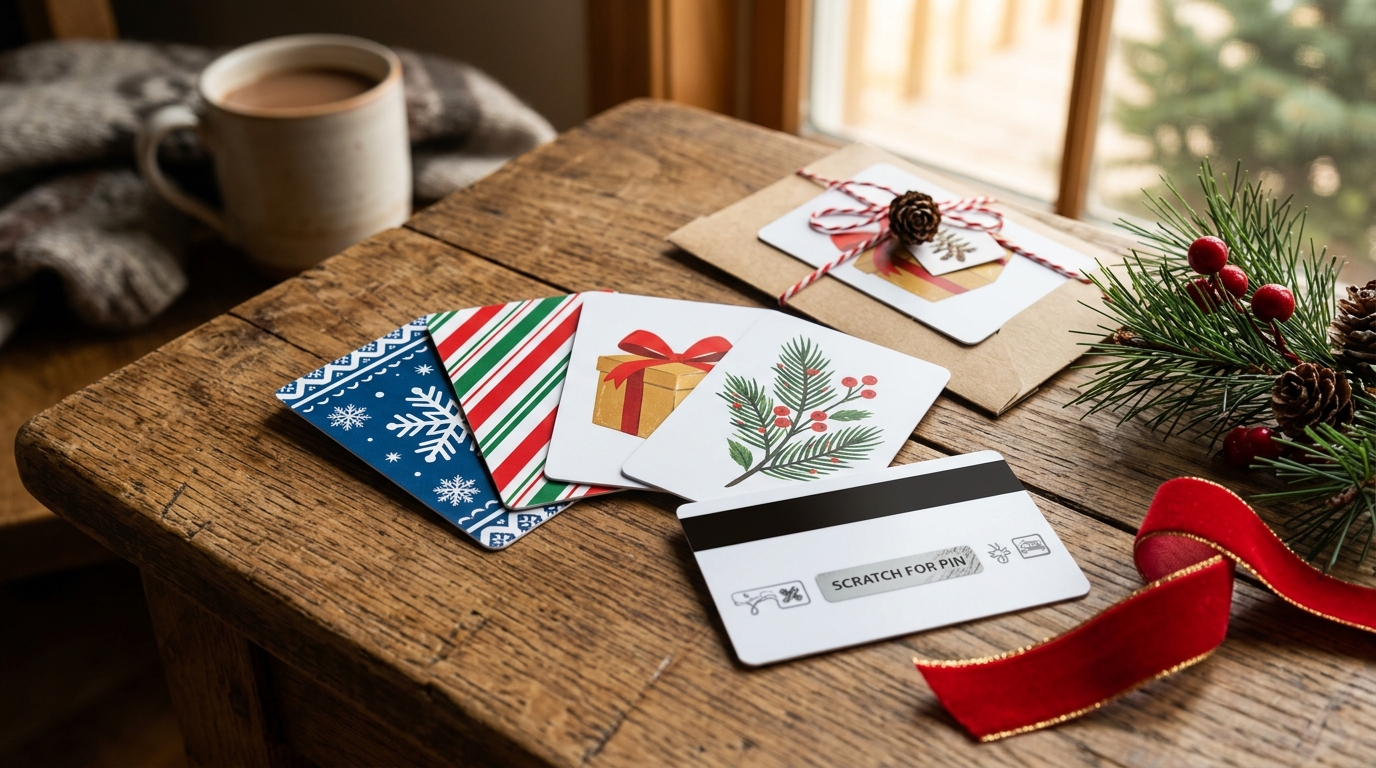
Sneaky, and low-tech. A scammer visits the rack first, lifts the protective sticker or scratches at the back, jots down the number and PIN, then slides the card back onto its hook. Then they wait. Once you load money onto it at the register, they can spend it online. They don’t need the plastic.
The FTC flagged this in December 2024. The D.C. Attorney General’s office warned about “draining” again in December 2025 and described other versions too, like swapping in a barcode that’s already been activated, or scanning codes off unsold cards. One detail from that alert is worth repeating: a card that looks untouched may still not be safe.
“Pay me in gift cards”
This one isn’t subtle once you know the rule. The FTC puts it flatly: only scammers tell you to buy a gift card and hand over the numbers.
Who do they pretend to be? The list is long. The IRS, the Social Security Administration, even the FTC itself. Tech support from a big-name company, warning about a virus. Your utility, threatening to cut the power today. A grandchild in trouble, and with voice cloning, the voice can sound right. A prize sponsor who needs a “fee” first. Someone you met on a dating site.
And your boss. In January 2026 the FTC described texts and emails from a fake manager asking for an urgent favor: buy some cards, send the codes. Sometimes the scammer won’t even say “gift cards” and calls them something like “Google certificates” instead. Urgency plus secrecy? That combination is the tell.
Copycat balance-check pages
Want to check what’s left on a card? Easy to do, and easy to get wrong. The card number and PIN are all a thief needs to spend the money. Type them into a look-alike page you found through a search ad and you may be handing both over.
That’s why a December 2025 campaign by Washington’s attorney general and AGs from 12 other states and the District of Columbia says to check balances only at the official retailer site. I’d go one step further and type in the web address printed on the card yourself.
Discounted cards from strangers
A $200 card for $150 on an auction site or social post looks like a deal. The FTC says to stick to stores you know and trust and avoid online auction sites, where cards may be fake or stolen. If the price feels too generous, there’s usually a reason.
Red flags at a glance
| Red flag | What it looks like | What to do |
|---|---|---|
| Damaged packaging | Torn or re-stuck sticker, scratched PIN area, PIN visible | Pick another card, show the damaged one to a cashier or manager, consider another store |
| Payment demanded in gift cards | “IRS,” utility, tech support, “your boss,” a relative in trouble | Stop. Hang up. Contact the person or agency using a number you already know |
| Request for the numbers on the back | “Read me the code” or “send a photo of the card” | Never share the number or PIN with anyone asking for payment |
| Balance page from a search ad or link | Site asks for card number and PIN | Use only the retailer’s official site or phone number on the card |
| Cheap cards from strangers | Big discount, auction site or social post | Buy from the retailer or a store you trust |
| Zero balance soon after buying | Card shows nothing or less than you loaded | Call the card issuer right away, keep the card and receipt, then report |
Buying and giving cards more safely
A few habits cut the risk a lot.
- Pick from behind the counter when you can. The D.C. AG suggests stores that keep cards at the register, lock them in racks, or hide barcodes until purchase.
- Inspect before you pay. Sticker intact, no scratches, PIN not showing. Something off? Grab a different card. The FTC notes that tampering may happen in batches.
- Pay with a credit card if you can. The FTC points out that credit card purchases come with stronger protections, and a chargeback may help if something goes wrong. May. A dispute is about the credit card charge itself, and the CFPB says the card company can reverse a charge only in some cases. A real card, properly loaded and drained by a thief weeks later? That’s misuse of the gift card balance, a different problem, and a chargeback isn’t guaranteed there. Your refund odds then often ride on the gift card company’s terms.
- Keep the receipt, and guard the codes. The FTC says the card number and store receipt help you report a card that doesn’t work. So hold on to the receipt and whatever identifies the purchase. If you write down the number and PIN (the CFPB suggests noting them), store that note as carefully as cash. A photo sitting in your camera roll isn’t that.
- Consider a digital gift card bought straight from the merchant’s own website or app. It skips the store rack entirely. Same rule as always, though: only from the real site.
- Give the receipt with the gift. The CFPB suggests passing along the terms and conditions and the receipt too.
- Register the card if the issuer allows it. Some issuers only replace cards that were registered first.
Gift cards vs. credit cards: not the same safety net
This is the part people miss.
If a thief uses your credit card, federal law generally caps what you owe for unauthorized charges at $50, according to the FTC, and you can dispute charges with your card issuer. Our guide on how to dispute a credit card charge walks through that process.
Gift cards? Much thinner. The CFPB says to protect a gift card like cash, and warns you might not get your money back if it’s lost or stolen. What happens next depends largely on the issuer’s terms.
Where federal law does have your back is fees and expiration dates. The rule lives in Regulation E, at 12 CFR 1005.20, and the short version sits in the table below. Your state may go further.
| Federal gift card rule (12 CFR 1005.20) | What it generally means |
|---|---|
| Expiration | Funds can’t expire for at least five years from when the card was issued or money was last loaded. The plastic itself can carry an earlier expiration date than the funds. If it does, the card must say so and list a toll-free number for a replacement, and the issuer generally can’t charge you for replacing it or for giving you the remaining balance another way before the funds expire (lost or stolen cards are the exception) |
| Dormancy, inactivity or service fees | Allowed only after at least 12 months with no activity on the card, and only if the fee amount, how often it can be charged and the fact that it’s for inactivity are disclosed on the card and before purchase. No more than one such fee per calendar month |
| Not covered (exclusions in 1005.20(b)) | Only cards that meet the rule’s definitions and conditions. A loyalty, award or promotional card is excluded only if it fits 1005.20(a)(4), which generally means it states on the front that it’s issued for loyalty, award or promotional purposes and shows the funds’ expiration date there, and, if the card has fees, discloses them along with a toll-free number for fee information (no number is needed when there are no fees). A reloadable card is excluded only if it isn’t marketed or labeled as a gift card or gift certificate. Other exclusions include cards usable solely for telephone services, paper-only certificates, cards not marketed to the general public, and cards redeemable solely for admission to certain events or venues |
Can you get your money back from a drained gift card?
Sometimes. Not always.
There’s no federal guarantee. The CFPB warns you might not get your money back if a card is lost or stolen, and points you to the card’s terms to see what happens next. The FTC’s version is a little more hopeful: some companies refund money that was frozen or that the scammer hadn’t used yet. Registered cards may also have better odds, since some issuers only replace those.
Bought it with a credit card? Worth asking your card company, though a drained balance isn’t the same as a disputed charge. Either way, the clock is the thing. Call fast, then follow the steps below.

Got hit? Move fast
Speed matters. The FTC says the faster you contact the gift card company, the better your chance of getting money back.
- Phone the gift card company first. Its number is usually on the card itself. Say the word “scam.” Last night or last spring, it doesn’t matter; the FTC says report it anyway. Then ask two things: is any money still on there, and can they freeze it?
- Push for a refund. Some companies do give money back if it was frozen or the scammer hadn’t used it yet. Not guaranteed. Still worth the awkward question.
- Hang on to the card and your receipt. Both, not one.
- File with the FTC at ReportFraud.ftc.gov.
- Did it start online? IC3 too. That’s the FBI’s complaint site, and you should type ic3.gov in by hand. Why so careful? In July 2026 the FBI said crooks were posing as “IC3” to hit scam victims a second time. The genuine IC3 won’t reach out to you first, and it never charges a fee to get money back.
- Loop in the store and your state attorney general’s office, especially for a tampered card.
Paid with a payment app instead? Our piece on payment app mistakes and scams covers that side. And if the “relative” on the phone sounded real, read up on AI voice cloning scams.
What to do this week
- Save the FTC’s line somewhere you’ll see it: only scammers ask for payment by gift card.
- Got an “emergency” call from family? Hang up and call that person back on a number you already know.
- Planning to give cards? Buy from behind the counter or from the merchant’s own site, and keep every receipt somewhere safe.
- Check old cards in the drawer on the official site printed on the back.
- Tell an older relative about card draining. Two minutes. Worth it.
Disclaimer: This article is for general educational purposes and is not financial or legal advice. Gift card terms vary by issuer and state law may add protections. Check the card’s terms and official sources, and contact the issuer and the authorities listed above if you suspect fraud.
Frequently Asked Questions
I paid a scammer with a gift card. Is the money gone for good?
Not always. Contact the gift card company right away. If the funds were frozen or not yet used, some companies may refund them. Then report it at ReportFraud.ftc.gov.
What is gift card draining?
A scammer copies the number and PIN from a card on the rack before you buy it, then spends the balance online once you load money onto it.
Do gift cards expire?
Under federal rules, gift card funds generally must last at least five years from issue or the last time money was loaded. Some states give more time. The plastic can expire sooner than the money, though, and in that case the issuer generally has to replace it without a fee.
Can a gift card charge inactivity fees?
Only after at least 12 months with no activity, if the fee is disclosed on the card and before purchase, and no more than one such fee per calendar month.
Is it safe to check my balance online?
On the retailer’s real website, sure, or through the phone number printed on the card. A balance page you reached from an ad, a text or a random link is a different story. Skip it.
Sources
- FTC: Avoiding and reporting gift card scams (consumer.ftc.gov/articles/avoiding-and-reporting-gift-card-scams)
- FTC: Check out gift cards before you buy them, Dec. 19, 2024 (consumer.ftc.gov/consumer-alerts/check-out-gift-cards-you-buy-them)
- FTC: No, that’s not your boss asking you to buy gift cards, Jan. 28, 2026 (consumer.ftc.gov/consumer-alerts/no-thats-not-your-boss-asking-you-buy-gift-cards)
- FTC: If you paid a scammer with a gift card, is your money gone? Maybe not, Aug. 21, 2023 (consumer.ftc.gov/consumer-alerts/if-you-paid-scammer-gift-card-your-money-gone-maybe-not)
- FTC: Consumer Sentinel Network Data Book 2024 (www.ftc.gov/system/files/ftc_gov/pdf)
- FTC: FTC testifies before Joint Economic Committee on efforts to combat fraud, Mar. 25, 2026 (www.ftc.gov/news-events/news/press-releases/ftc-testifies-joint-economic-committee-agencys-efforts-combat-fraud)
- FTC: Testimony, JEC hearing on the rising scam economy (www.ftc.gov/system/files/ftc_gov/pdf/ftc-testimony-jec-hearing-on-the-rising-scam-economy.pdf)
- FTC: Lost or stolen credit, ATM, and debit cards (consumer.ftc.gov/articles/lost-or-stolen-credit-atm-and-debit-cards)
- CFPB: Regulation E, 12 CFR 1005.20, Requirements for gift cards and gift certificates (www.consumerfinance.gov/rules-policy/regulations)
- CFPB: If my prepaid card expires, do I lose my money? (www.consumerfinance.gov/ask-cfpb)
- CFPB: Unwrapping gift cards (files.consumerfinance.gov/documents)
- CFPB: How can I get a refund on a product or service I purchased with my credit card? (www.consumerfinance.gov/ask-cfpb)
- Office of the Attorney General for the District of Columbia: Alert on gift card scams, Dec. 15, 2025 (oag.dc.gov/release/attorney-general-brian-schwalb-issues-alert)
- Washington State Office of the Attorney General: Watch out for gift card fraud this holiday season, attorneys general warn, Dec. 22, 2025 (www.atg.wa.gov/news/news-releases/watch-out-gift-card-fraud-holiday-season-attorneys-general-warn)
- FBI IC3: FBI Warns of Scammers Impersonating the IC3, July 20, 2026 (www.ic3.gov/PSA)